A matter of perspective...


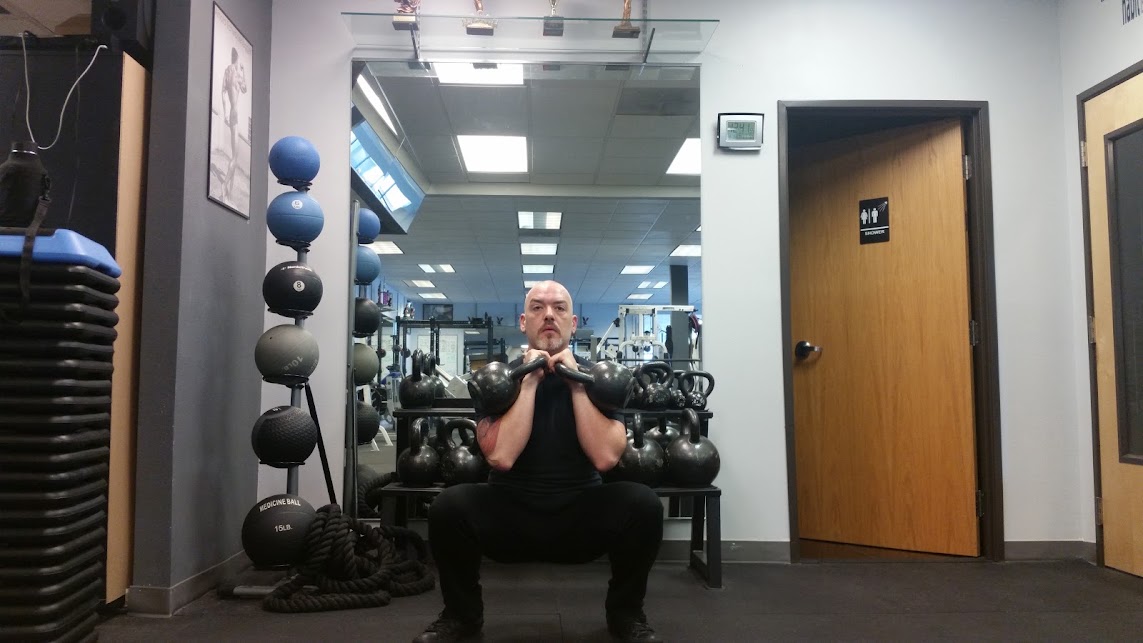
70lbs rack position kettlebell squat for no reason.

Today I had an interesting talk with a client and it reminded me of how important perspective is and how easily it can change. My clients and I do bi-weekly recording of skin-fold pinches with a medical grade caliper. We also do tape measurements and we use this information in determining macro and calorie counts, tracking and measuring progress and for me to decide if I'm happy with the training direction.


I was talking with one of my newer clients whom I have been training for about a month and we were talking about his week. My client mentioned he had a really rotten day and the week had not been great either. He had missed a few workouts and just didn't feel as pumped as the previous week. His update showed progress in the direction we wanted but not as much of a drop in bodyfat as I expected so our talks turned to the week's nutrition. He mentioned he had 2 Klondike bars and a light beer this week.

This made a bunch of bells and whistles go off and red lights flashed and my pulse raced a little. Klondike bars and beer! To me, this was definitely the reason that his update wasn't what I expected, in addition to the stress of the week and the missed gym sessions. He then said something that completely shut my internal alarm system up and hit the breaks on my thought process. He reminded me that a few short weeks ago he was eating candy and drinking soda and having Klondikes whenever he wanted and that this was definitely better.

Google Image Search for Perspective Shift. Fancy!

You're right man, you're doing a helluva lot better. Great job in fact! And thank you for reminding me that perspective is everything. When I first started my own lifestyle change I would have thought exactly the same way as he did. 2 Klondikes and a light beer is a hell of an improvement over the way I used to eat as well. And if I didn't spend so much time working on my own fitness and around other people on the same path I would still have that same perspective. Now I reserve sugary fatty treats like that for refeed days, and frankly I use my refeeds for pizza or burgers usually.

We did talk about this in more detail and I talked to him about refeed meals, and saving those times that he needs a Klondike bar or a light beer up and using them to his advantage the way a bodybuilding competitor would. I also found this great article  about competitor mindset and I shared this with my clients in the Facebook group for BSFFitness. I really enjoy working with clients and being reminded of how my perspective changes, and how it's ALL a matter of perspective. If you're working hard and making progress, even baby steps are working in the right direction. It's good to remind myself of this too.

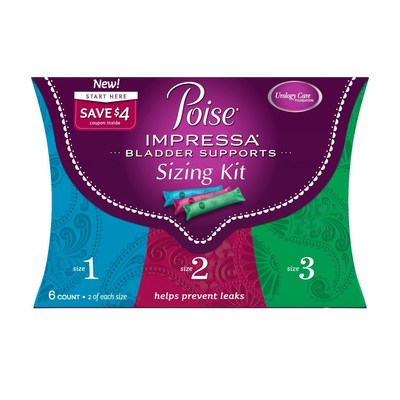
Guest Post: Poise Bladder Support Review or How I Stopped Peeing Myself When Weightlifting

There are things in life that many women don’t want to talk about so we suffer in silence and just deal with some of the unpleasantness of being a woman. Specifically, both women who have given birth or women who reach their early 40s or 50s can have a problem with bladder control. I’m not talking about incontinence; I’m talking about those annoying leaks that happen when you run or jump or deadlift. The leaks that happen with either sudden force or serious core pressure needed for big lifts. You can do Kegels until the cows come home, but sometimes that just isn’t enough and leaks still happen. It’s embarrassing and frustrating and makes you want to not do those activities even more.

I would always make sure to empty my bladder before big lifts and wear a panty liner just in case because usually even if there was a leak, it wasn’t that significant. However, it became evident that this was something I needed to address when I went to a trampoline park. I was an embarrassed mess in short order even though I made sure to pee before I jumped. Within the first 5 minutes of bouncing it was disastrous. No one could tell, but I was mortified and vowed that if I couldn’t get this under control, I was never going again. I didn’t want to wear those bulky incontinence pads because I’m only 46, I’m in great shape and I wasn’t ready to feel like a granny.

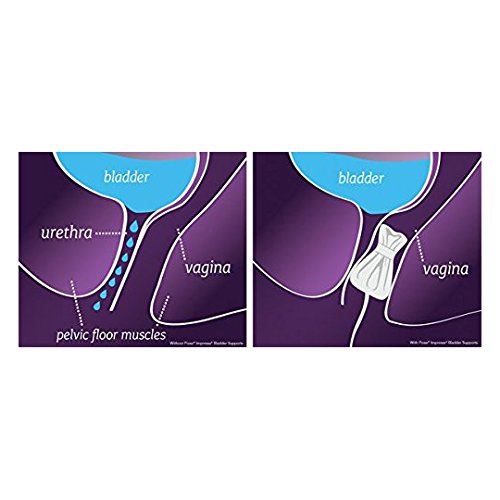
Then I saw these in the store and went… hmm, why not try them? They are little insertable plastic frameworks covered in a safe cloth that helps to support the bladder during jarring movements.


I decided that I needed to experiment to see how well they worked. They start out with a sizing package to see how much control you need. I tried the smallest size first and had absolutely no issues while weightlifting and running! The real test however, was going to be at the trampoline park. I started wearing the smallest with one of the bulky pads just to check and brought more pads and the other sizes just in case. The smallest failed within minutes so off to the bathroom and new pad, and insert a size 2. That one also failed within minutes and at this point I’m getting discouraged. The size 2 I was able to actually feel inside me which is really distracting. Finally, another pad change and on to the largest size 3. This one was actually uncomfortable to wear and although it didn’t fail fully, there were some minor leaks that a panty liner would hold.


Experiments over, here are my personal takeaways. First, for anything other than super crazy bouncing, these work like a charm and are comfortable and give me peace of mind in the gym or on a run. For bouncing, although the largest did finally work, it was too uncomfortable and made me hyper aware of what I was doing. I honestly think that for me, the bulky pad was a better option as it allowed the same freedom of motion without the discomfort. Your mileage with these may vary but other than going crazy on a trampoline for hours, these are definitely worth my time and money.

Tina
akaTrainer's Girlfriend
aka His biggest pain in the butt client

Announcing the Better, Stronger, Faster Fitness Windows10 App!

I'm very excited to announce the Better, Stronger, Faster Fitness‪ #‎Windows10‬ app! If you're using Windows 10 or a Windows ‪#‎Mobile‬phone you can download our app and find all of our Facebook, Instagram and Twitter posts, collected in one place! Read client and trainer blogs, without leaving the app! Check out our informative and inspirational Youtube videos! Have easy access to contact me via phone, text or email and see online training options.
I'd love to hear what my friends have to say about this application. Please download from the Windows 10 store, install and review it. I'm excited to hear what you think! Leave me feedback and help me to make the app even better for you!
https://www.microsoft.com/store/apps/9nblggh68789

First update of 2015!

I looked at the blog the other day and realized it's been a really long time since I posted anything, so I decided to give a quick update on what I've been up to!

New Website:
A lot of last year was focused on getting the webpage up and running and that is done now. My friend Deb surprised me with a complete redesign for Christmas and I think the new page is amazing. I think it's a great face for the business and looks sharp. I love that we have two different blogs now and there's lots of ways I can add to the page to make things even better in the future.

We also added some guest bloggers and now we have a client blog! You can check it out here: http://www.betterstrongerfasterfitness.com/client-s-blog.html

I really like this for a lot of reasons. I get to hear things about their training from a perspective that I wouldn't get just by asking how they are doing. I am entertained  by what they write and I think that it's fun to read. I think it gives prospective clients a new view into training with me that they wouldn't otherwise have. I can tell people about what it's like all day long but to hear from an existing client and to watch their journey is invaluable. I have heard positive responses about the client blogs and I'm really excited to follow their progress.

The Gym:
In addition to having access to Genuine Fitness LLC's personal training studio, my clients and I also have access to the Garage Gym and Coffee Club, conveniently located next door. This is due to a cooperative agreement between Aaron and Randy. This is really exciting for me because it means I have even more space and tools available to give my clients a challenging session and we can change things up. We'll also be adding showers sometime in the next month. I'm really excited about all of the changes happening at the gym! You guys help to make this happen by training with me, being consistent and showing your friends all of your hard work!


My Training:
I've really focused a lot of my own training on kettlebells and powerlifting. I've learned a lot from reading books and articles and watching videos by RKC, SFG, Pavel Tsatsouline, Brett Jones and Gray Cook. I really read these guys' works over and over and practice, practice, practice. My current weight used for most of my swings is 70lbs. I do Turkish Getups with 53lbs. I think I'm ready to go up to 60 but I may have to use a dumbbell because we don't have a 62lb kettlebell in the gym. My next closest jump with my available kettlebells would be to the 70lbs. My clients have definitely felt the results of all of my study. It's not uncommon to come into the gym and see them doing Halos, Windmills, Swings, Turkish Getups and all kinds of other kettlebell training exercises.

I turned 39 last week! At 39 years old, I'm in the best shape of my life. I'm stronger than I've ever been. I'm running faster and for extended periods of time. My explosive power is still increasing with training. I think aesthetically I look better than I ever have. Reflecting on how far I've come makes me excited! When I first started this journey I was fat and miserable and sick and weak. I could barely get 95lbs off of the floor when I first started seriously deadlifting 3 years ago, and now (after a break to get hernia surgery to repair damage from when I was heavy) I'm pulling 325lbs with no straps and no belt, and I'm still making gains. I consistently grow and learn because I'm still making progress and finding all of the best things that work for me and for my clients.

My Clients!:
I've really expanded my client base! For a long time my main focus as a trainer was in helping people lose weight. This was great because there's plenty of people that need help and I can relate really well to the challenges that this population faces because of my history. In the last 6 months or so I've started really training a lot of other types of people. Many of my clients are women of college age or older who are struggling to put weight on their frames. Many of them want to have abs or bigger, stronger butts. I am successful with these clients because I read a lot of work by Bret Contreras. He's kind of a big deal where fitness and butts intersect and he's done all of the work for the rest of us and isn't afraid to share it. I learn a lot by following his writing. I also have a number of clients who are new to lifting and want to learn the best way to do it without injury. I specialize in injury prevention and strengthening imbalances to help you stay in the game longer. Injury interferes with training and must be eliminated or reduced. Learning to train with proper form goes a long way in keeping your joints, muscles and bones healthy. I do a modified screening inspired by the Functional Movement Screen (written by Gray Cook. There's that name again!) with all of my clients and we really work to address any problems that we come across. I've also done a lot more work lately with clients who are interested in working around or strengthening old injuries, everything from torn ACLs to spinal discectomy! I really enjoy the challenges this presents. It helps to keep me learning!

Final Thoughts:
One last thing I want to say - I'm really disappointed that there will be no Portland Tough Mudder this year. I really enjoyed last year but logistics may keep me from being able to do Seattle's Tough Mudder. I'm considering either trying to work that out or limiting myself to doing Warrior Dash in 2015. I still haven't decided, but I'd like to put a team together if I'm going to. If anyone reading this blog is interested in joining Team Better, Stronger, Faster Fitness at the Tough Mudder in Seattle or the Warrior Dash in Portland area, message me and let me know! Your messages may help turn the tide of my decisions. That's all for now! Thanks for reading!
I'll leave you with pictures of my super cool in-progress tattoo. It's an anatomical view of the rotator cuff muscles and the other muscles of the shoulder. I expect to continue this view all the way down the arm and over part of my trunk eventually. I think it's awesome and it may be a fun way to illustrate things to my clients eventually.

A Review of Portland Tough Mudder...

This is my review of the Portland Tough Mudder in Lebanon, Oregon, August 9th, 2014 . I have included links to the event as well as links to videos on Youtube of each obstacle. I want to be clear that the Youtube videos are not mine, I have only included them for my friends to see the obstacles. Whenever possible I include video from the Portland event, but some of the clips are other races. The course was approximately 10.1 miles with 2500+ total feet of elevation and 20 obstacles. Tough Mudder's map said that the average participant time should have us finishing between 2:45 and 3:15. Since this was the first Tough Mudder I ran my goal was 3:15.

There wasn't a lot of signage on the way to the event to indicate it was happening in the tiny town of Lebanon. Although I was familiar with the area, I bet a lot of people were nervous about getting lost on the way to the race. Once we arrived, I was glad to see the parking areas were close to the main area we would be entering after the race. I was disappointed to have to pay for parking though. This was not a cheap race to run and adding another $15 for parking was lame.

The main area had a number of food vendors and sponsors booths. There was also a tent to buy Mudder gear. Tina and I bought a pair of Maxi Grip gloves and a Tshirt each. Usually when I've purchased a race shirt along with a registration the shirts are terrible quality and ugly and I barely even wear them. The shirts at Mudder were high quality UnderArmour gear. The gloves were also really great and seemed as though they would be much better for the course than the work gloves we brought along with us, so we changed into them.

Our heat started at 9:20 and we made our way to the "warm up area" at about 9am. There was a group instructor with a microphone doing warm up exercises that seemed more like team-motivation exercises than an actual warm-up. Then the previous heat started and we all emptied out of the warm-up area to the start line. Before we got to the start line, there was a 6 foot wall that we had to scale. This was a taste of things to come, before we even began! There was an MC at the start line, working the crowd and telling jokes and taking pictures to Instagram. He was entertaining and helped to pass the time. Just before we started, Tina turned to me and said that all of the nervousness she had been feeling in the weeks leading up to this race vanished as we were standing there. This made me really happy because we trained hard and it made me glad that she felt ready.

The first obstacle we encountered was near the one mile mark and it was Kiss of Mud. This was a mud pit with barbed wire stretched across the top. Get under the wire and covered in mud, crawl through until the end. This was an easy obstacle. I was glad that I had a chance to run for awhile before I got into the mud because it felt kind of nice.

The next obstacle was the Mud Mile. This was a series of 6+ foot deep mud walls with mud pits between them. To get out of the pit you had to rely on teamwork, either giving you a leg up or grabbing your hand to help you get to the top of each wall. Tina and I met a couple from Vancouver who were in the mud with us and at this point we agreed we should all team up for awhile to help each other through the course.

Next came Pitfall.  This was a mud pit with an electric wire and barbed wire stretched over top. In the beginning you duck under the wire and then crawl through the mud pit being careful to not get snagged on the barb wire. I was able to get under without a shock but the girl next to me got it in the shoulder. She said it definitely stung.

Next was Killa Gorilla. The link I provided is not Portland's course but it looked a bit like the one in that video. It was basically just a section on the side of a great big hill that they made an up and down repeating course to wear you out.

After KG came Walk the Plank. This was not an obstacle I was looking forward to because I'm scared of heights and sometimes I even get vertigo. I was nervous going into this one and I thought it would be better once I was standing in front of it, but I was still really anxious. When I got to the top of the plank I paused a lot longer than I hoped to and I felt my head start to spin a little but there were people behind me and I didn't want to hold them up so I went for it and jumped. The drop was about 12 feet into cold water with a swim to a net on the other side. I have no problem swimming so I made it across just fine. This was the first obstacle that really made me uncomfortable and challenged me and pushed me past my comfort zone. I felt really accomplished afterward and it helped charge me up for the rest of what I had to face.

The Glory Blades were the next obstacles on the course. They were walls that we facing toward you at about a 45 degree angle. You had to scale over them and slide down the other side. This was actually easier than I expected. I helped my team over the wall and then used the supports on the side to hop right over.

There was a short run after the Glory Blades and we came to the Arctic Enema. This obstacle is a dumpster filled with ice and water. It has a wall in the center and you have to pull yourself underwater and under that wall and come out on the other side. I was pretty prepared for this because I went swimming last week in the McKenzie River and it was almost that cold. Tough Mudder claims that there is 25000 pounds of ice used in this obstacle.

Muddersection was just a great big mud pit. Climb down, wade, climb up. We went through this one twice.

BaleBonds was not too tough, but when I first started up the rope I couldn't get my feet dug in well and didn't pull my body close enough to the wall so I slowed for a second until I could fix that. Up and over!

I've determined that it has to be our volcanic soil that makes obstacles like Trench Warfare so painful. I swear our dirt here is just sharp and with both Tough Mudder and Warrior Dash I come out all cut up on my shins from it. The being underground part wasn't so bad but being cut to ribbons always sucks.

Hold Your Wood was the next obstacle on the course. This was literally just taking a huge log and carrying it for a certain distance. It was pretty far (two hundred yards?) and my shoulders were burning by the time we finished. I think my log was about 40 pounds and it was awkward. I'm glad I spent so much of my summer helping to the clear the woods at OCF because I think it definitely helped me prepare for this.

Berlin Walls were next. These were a few 10-12 foot walls we had to scale. I helped with leg ups and used the boards on the side to pull myself up and over. I was really pleased at how easy things like scaling walls seemed. I haven't had a lot of practice with this and don't have an obstacle course training area yet so I just did lots of pulling in my strength training and it translated well.

Cliffhanger was an obstacle as well but I didn't find a good video. This was basically just a steep-ass hill that we had to climb. There were parts of it that I'm sure were at a 45 degree angle. It was incredibly difficult to run up this and I stopped and walked at many parts. Within a one mile section we had 1000 feet of elevation. It reminded me of trail running events with my crazy EH3 friends, but with less beer. It was hot on that hill and it would have been nice to have a water station near the cell tower.

After Cliffhanger we finally reached the top of the hill and then started the treacherous downhill. Running downhill is hard and beats up your knees. When you mix in the rough terrain, rocks, tree branches and other people navigating it can take a lot out of you. We were about 2/3 of the way down the hill when we came upon the Devil's Beard. This was a cargo net stretched over the course and you had to get underneath it and crawl through. It was a lot tougher than it looked with the cargo net pressing down on you and at this point I could really feel the 7 miles we had run so far.

With Devil's Beard behind us, we arrived at the Warrior Carry. The Warrior Carry is an obstacle that Tough Mudder included to honor and raise awareness for the Wounded Warrior Project. This is a great charity that Mudder is involved with to help wounded veterans. The point of the obstacle is to carry your partner through the designated area. There was a switch point at the midway where you change positions and your partner carries you. My teammate (Tina) and I decided I would just carry her through both points instead of having her try to carry me because at this point in the race she wasn't sure how far she could go with me on her back. We came to the end of the obstacle and I set her down and we continued on!

After the Warrior Carry was Bushwhacked. This was just a steep rocky and wooded area that was pretty typical of any trail in Oregon. If you've done any trail running nearby you would probably encounter the same type of stuff. This was not particularly challenging and it didn't really seem to have a start or end. Hard to call this one an obstacle.

Prairie Dog was the next obstacle on the course. This was the toughest obstacle for me. The obstacle consisted of tubes with the entrance low and the exit higher up in the air. Each tube was slick on the inside, with a knotted rope running through the middle. By the time I got to this obstacle the rope and inside walls were both so slick with mud I could barely hang on. It was extremely difficult to pull myself up this rope. Right about midway I started feeling a little claustrophobic and trapped. My muscles were tired and I was mentally pretty exhausted too. I really had to push myself to keep moving and stop thinking defeating thoughts. I thought to myself that the movement I was using was a lot like a dumbbell pullover and I need to keep increasing my weight for these in my program more than I thought. Thinking about my training helped me keep moving. Once I got my head back on tight I moved past a few more knots and saw Tina reach down into the tube. I grabbed her hand and she helped pull me out. I was very glad to be out of that tube.

Next up was the Quagmire. This was yet another deep mud pit. There was no teamwork required to get through this one. The mud was a little stickier than previous mud but that was about it.

Everest was another obstacle that I wasn't sure if I'd be able to finish when I was looking at videos online. Once I got to it in person I was feeling a bit better. Basically you have to run up a quarter pipe and jump at just the right time to catch the lip at the top. They slick the pipe with vaseline, cooking oil, or whatever else they feel like at that moment. If you don't jump at the right point you don't make it to the top. This one took me two tries. I was able to grab the lip at the top on my second try but I needed someone to lend me a hand to climb up. I stayed at the top and helped Tina and another guy and his girlfriend to the top and then continued on.

The last Obstacle in Tough Mudder Portland was Electro Shock Therapy. I'm going to be honest here, I was DREADING this one. 10,000 volts, 50 feet long. Thousands of wires hanging down over mud. You get to run, walk, crawl or otherwise spasm your way through. I used to have horses as a kid and we had an electrical fence around the corral. As a matter of course sometimes you forget the fence is on or try to be fast and sneak between and you inevitably get shocked. This happened to me a lot as a kid (can you tell?) I expected that the shock I got from Electro Shock Therapy would be a little less than this jolt I used to get occasionally and I would be fine.

I reached up and grabbed one of the wires to test the zap and didn't get a jolt at all. I used the other hand to press it to the inside of my forearm to test and came back with a big popping zap that hurt just as much as the fence I remembered as a kid. They didn't turn this sucker down AT ALL. My arm hurt, my stomach lurched, I felt a little tingle in my leg where my foot was in a puddle. I had to stand there for minute or two and psyche myself up to get to the point I could do it. I backed up and sprinted as hard as I could through the hanging wires. I know they worked on a pulse so I thought if I went quickly enough I may be able to avoid some of the pain by catching in the middle of a cycle. I felt a few small zaps from the first row, and about 4 more from the second row. As I was almost through the second row I felt a wire wrap around my head and I caught a huge zap right in the temple. I felt another brush my face and give me another jolt and then I fell. I was actually dizzy and nauseous and for a second a forgot to breathe. I raised up onto my hands and knees and heard an announcer telling me to keep going. I started to stand and got another zap. That was enough for me and I threw myself forward and through the last row of wire with only another small zap or two as I went through. I think I got it about 8 times total. I'm really glad that was the last obstacle because my muscles were all cramping and pissed and I was hot and miserable and sore. I know this doesn't sound like a very positive review at this point BUT I HAD SO MUCH FUN!

As you cross the finish line after all the electrocution, lovely ladies award you with your prize: The coveted orange Tough Mudder headband. They even let you give them incredibly muddy hugs!

The course support was great. Where normal races may have water, this had water and bananas at nearly every stop. There were also electrolyte gels and protein bar samples from race sponsors. At the end you get a free Dos XX beer, which tasted incredible after running 10 miles and beating myself up.

The food vendors were fine and the prices were good. I had a beer and a corndog and a Coke and it was great. There was an area to clean off, a bag check (proceeds partially benefit Wounder Warrior Project) and a changing area. When I ran Warrior Dash, you had to clean off in the lake and it sucked so it was nice to have running water to clean the layers of crud off. Good job with that Tough Mudder! Finally we picked up our finishers shirts and headed to the car, exhausted but elated.


Tough Mudder for me was a symbol. When I started running in 2010 I set my goals on being able to complete Warrior Dash. Warrior Dash is a similarly themed event with mud and obstacles that stretches out over 3 miles. When I started training for Warrior Dash I couldn't even run a mile without stopping and I was weak and flabby. Even after running 3 Warrior Dashes successfully, I was still intimidated by Tough Mudder. It was the obstacle course designed by British Special Forces! You had to be really fit to complete a Tough Mudder. I didn't know if I'd ever be up for the challenge, but sometime last year Tina and I decided to register for it. We began training in earnest, running the Ridgeline Trail and around Spencer's Butte. We did lots of lifting and functional training in the gym to prepare and I programmed grueling kettelebell and circuit training sessions to help us get lean and mentally tough. We did intervals, we did sprints, we did endless Turkish Getups and Bulgarian Split Squats. As hard as the training was, I felt prepared for Mudder once I got there. My teammate Tina and I both trusted our training and it carried us through. I wanted to complete the course in 3:15 but it took us 4:30. At the end I wasn't disappointed because it wasn't about time as much as completion and helping your team. As a two person team, (but with plenty of help from our fellow Mudders) we took something that we never thought we'd be able to complete successfully and turned it into a great achievement that we're looking forward to improving upon next year! What I'm getting out of my training is feeling amazing about myself and my body and the things I can do with it. It gets better all the time!

Want to join us for Tough Mudder Portland 2015? Leave a comment below or contact me via email and we'll conquer it together!
Let's Talk About... Chronic and Degenerative Diseases of the Cardiovascular System.

I know I talk a lot about having the "body you want" and this is frequently related to the physical appearance, bodyfat to lean mass ratio, and other slightly less easily quantified things like energy level and overall sense of well-being. One thing that we don't talk about frequently is the impact that lifestyle has on health. By health I mean long term health and longevity - feeling good and not being sick, including what's going on inside your body where you can't see. 

According to the book Physiology of Sport and Exercise, "Chronic and degenerative diseases of the cardiovascular system are the major cause of serious illness and death in the United States." Additionally, cardiovascular diseases (CVD) accounted for 34.5% of all deaths in the US in 2006! That's one out of every 2.9 deaths. In the 1970s, CVD accounted for over 50% of all deaths. Coronary heart disease (CHD) is responsible for 17% of deaths (2006) but was responsible for almost a third of deaths in the 1970s. CHD is 53% of CVD deaths each year. 

A healthy amount of exercise and being mindful of your nutrition are one of the best things you can do to improve your health and extend your quality of life. So what is a "healthy amount of exercise"? Here are part of the ACSM's exercise guidelines for adults for 2011.

Cardiorespiratory Exercise


  • Adults should get at least 150 minutes of moderate-intensity exercise per week. 
  • Exercise recommendations can be met through 30-60 minutes of moderate-intensity exercise (five days per week) or 20-60 minutes of vigorous-intensity exercise (three days per week).
  • One continuous session and multiple shorter sessions (of at least 10 minutes) are both acceptable to accumulate desired amount of daily exercise.  
  • Gradual progression of exercise time, frequency and intensity is recommended for best adherence and least injury risk.
  • People unable to meet these minimums can still benefit from some activity.

Resistance Exercise


  • Adults should train each major muscle group two or three days each week using a variety of exercises and equipment.
  • Very light or light intensity is best for older persons or previously sedentary adults starting exercise.
  • Two to four sets of each exercise will help adults improve strength and power.
  • For each exercise, 8-12 repetitions improve strength and power, 10-15 repetitions improve strength in middle-age and older persons starting exercise, and 15-20 repetitions improve muscular endurance.
  • Adults should wait at least 48 hours between resistance training sessions.


Flexibility Exercise


  • Adults should do flexibility exercises at least two or three days each week to improve range of motion.
  • Each stretch should be held for 10-30 seconds to the point of tightness or slight discomfort.
  • Repeat each stretch two to four times, accumulating 60 seconds per stretch.
  • Static, dynamic, ballistic and PNF stretches are all effective.
  • Flexibility exercise is most effective when the muscle is warm. Try light aerobic activity or a hot bath to warm the muscles before stretching.


Neuromotor Exercise


  • Neuromotor exercise (sometimes called “functional fitness training”) is recommended for two or three days per week.
  • Exercises should involve motor skills (balance, agility, coordination and gait), proprioceptive exercise training and multifaceted activities (tai ji and yoga) to improve physical function and prevent falls in older adults.
  • 20-30 minutes per day is appropriate for neuromotor exercise.


Risk Factors


So how do you know if you're at risk for cardiovascular diseases such as coronary heart disease? Here are some risk factors you can change to help reduce your risk:
  • Smoking tobacco
  • Hypertension
  • Abnormal blood lipids or proteins
  • Physical inactivity
  • Obesity and overweight
  • Diabetes (type2) and insulin resistance


With a list like that it seems like it would be pretty easy for us all to reduce our risk of cardiovascular disease but as a society we don't worry as much about our health and quality of life as we do how much money we make or whether we are playing the latest video games. The health of our cardiovascular systems almost never crosses our minds unless we have a scare or know someone else who does. People begrudgingly say "my doctor told me to lose weight" and act as though they're being punished. 150 minutes a week is all it takes to make a big difference in your health according to the ACSM. That's only 2 and a half hours. Do you have 2 and a half hours a week to help yourself live a long and happy life?

Kenney, W. Larry; Wilmore, Jack; Costill, David (2014-06-18). Physiology of Sport and Exercise, Fifth Edition (Kindle Locations 19146-19147). Human Kinetics. Kindle Edition