BSFFitness Basics Series: Better Squats! Box Squat Regression
Today I have a new BSFFitness Basics Series entry for you! If you're still working on getting the proper depth for your squat, box squats are a great method to help you progress! In this video Christy and I demonstrate how to use an adjustable height riser to drop your squat from a quarter all the way to parallel. A parallel or below parallel squat demands more glute involvement so if your anatomy allows you do to so safely you should strive for depth to build that booty.
Acro - Running Bird on Hands with Tiffany
Been working on this cool trick with Tiffany for just a little while now. I'm really excited at how far it's come, and how quickly!
BSFFitness Basics Series: Better Squats! Intro to Squat Form
I decided to start filming basic exercises to share with my clients and to include video examples in my online training programs. It made sense for me to make the first one about squats!
Here's the first of the BSFFitness Basics Series. Better Squats! An Intro to Squat Form.
Check it out and let me know what you think in the comments!
Book Review: Foam Rolling by Sam Woodworth

Today I'm going to share my thoughts about Foam Rolling by Sam Woodworth. DK was nice enough to send along a free review copy of this book but I'll say right off the bat that as a reference book or to use for inspiration in putting together a nice mobility plan, I would have paid the $19.95 cover price for it. I would recommend this book to clients and readers of my blog with one caveat which I will detail in my review.
I like the layout of this book a lot. It is divided into 7 sections.
Sam continues to talk about effective rolling, what you need including sports balls and other random implements you can use for mobility work, and things to know before you begin. A good addition to the "other tools" list on pg.19 might be a common trick called a peanut where you tape two tennis balls together and use it for trigger point release. A simple Google Search will return lots of information on this topic.

In Section 2,Core Exercises, Sam gives us a mixture of common bodyweight exercises that have been modified to include use of foam roller and foam roller and tool specific massage and release practices. Section 3 and Section 4 continue the same way using exercises, stretches and releases from the lower and upper body respectively.

Section 5 changes gears on us again with Pain Relief Programs. This section is made up of recipes with exercises, tools and page numbers referring us to previous information in the book. It runs through the entire body in areas like Shoulder and Neck, Hips, Hand and Forearm, etc. In the section for hips I read carefully to see if there was any reference to caution when foam rolling the area of the greater trochanter of the hip to prevent greater trochanteric bursitis but found none. This information would be appropriately placed on pages 70 or 71. I make sure to tell my clients about this because I think it should be included in any discussion of foam rolling the area of the hip.
Section 6, Lifestyle Programs continues the recipe trend. This section includes pages on Too Much Sitting, Stress Relief and Postural Restoration and much more.
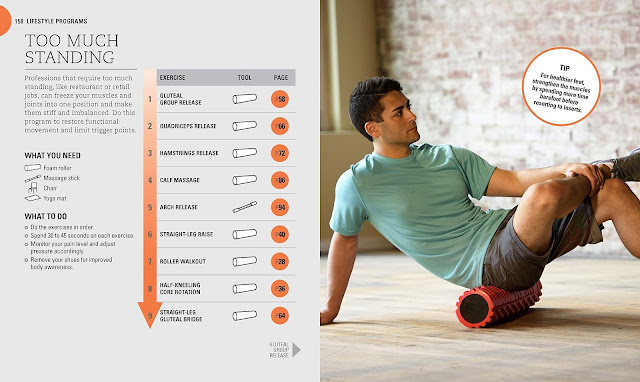
Section 7 is Sports Programs. There are pages for PreWorkout recipes, Post Workout recipes, Straight Line Sports, Rotational Sports and Overhead Sports.
This book feels like quality material. It is packed with great info and has lots of helpful photographs to explain the concepts and movements. The book is very well thought out and well illustrated. There are information bubbles and tips and info scattered throughout. My only criticism of the book is the omission of the previously mentioned info about the hips. I would recommend this book to my clients and readers. I think it's a fair price for a good reference manual.If you have any questions or comments about this review please feel free to leave them in the comments or contact me directly! Have fun foam rolling and doing some tissue maintenance!
I like the layout of this book a lot. It is divided into 7 sections.
- Foam Rolling Basics
- Core Exercises
- Lower Body Exercises
- Upper Body Exercises
- Pain Relief Programs
- Lifestyle Programs
- Sports Programs
Sam continues to talk about effective rolling, what you need including sports balls and other random implements you can use for mobility work, and things to know before you begin. A good addition to the "other tools" list on pg.19 might be a common trick called a peanut where you tape two tennis balls together and use it for trigger point release. A simple Google Search will return lots of information on this topic.

In Section 2,Core Exercises, Sam gives us a mixture of common bodyweight exercises that have been modified to include use of foam roller and foam roller and tool specific massage and release practices. Section 3 and Section 4 continue the same way using exercises, stretches and releases from the lower and upper body respectively.

Section 5 changes gears on us again with Pain Relief Programs. This section is made up of recipes with exercises, tools and page numbers referring us to previous information in the book. It runs through the entire body in areas like Shoulder and Neck, Hips, Hand and Forearm, etc. In the section for hips I read carefully to see if there was any reference to caution when foam rolling the area of the greater trochanter of the hip to prevent greater trochanteric bursitis but found none. This information would be appropriately placed on pages 70 or 71. I make sure to tell my clients about this because I think it should be included in any discussion of foam rolling the area of the hip.
Section 6, Lifestyle Programs continues the recipe trend. This section includes pages on Too Much Sitting, Stress Relief and Postural Restoration and much more.

Section 7 is Sports Programs. There are pages for PreWorkout recipes, Post Workout recipes, Straight Line Sports, Rotational Sports and Overhead Sports.
This book feels like quality material. It is packed with great info and has lots of helpful photographs to explain the concepts and movements. The book is very well thought out and well illustrated. There are information bubbles and tips and info scattered throughout. My only criticism of the book is the omission of the previously mentioned info about the hips. I would recommend this book to my clients and readers. I think it's a fair price for a good reference manual.If you have any questions or comments about this review please feel free to leave them in the comments or contact me directly! Have fun foam rolling and doing some tissue maintenance!
Subscribe to:
Posts
(
Atom
)